![]() |
|
|
|
|
||||||||||||||||
|
Windlass Steelcrafts Cinquedea Sword
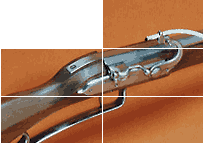
A hands-on review by Gene George Introduction The Cinquedea is one of the most distinct styles of weapon to emerge from the Italian renaissance. Based in no small part on ancient Greek and Mycenaean Bronze Age and early Iron Age sword and dagger styles it has been upheld by many historians as a paragon of Italian renaissance design, a literal rebirth of classical values and aesthetics. The name cinquedea comes from the Italian for "five fingers" a reference to the blade's wide width, it is also known as an ox-tongue dagger (langue de boeuf). Although most describe the cinquedea as a dagger or short sword, a few larger weapons survive in collections around the world. Windlass Steelcrafts, the parent company of Museum Replicas Limited of Atlanta, Georgia produced this piece. They market low to moderately-priced historical weapon replicas and fantasy pieces. This piece was ordered from Museum Replicas and is, as of this writing (May 2003) on clearance at a discounted price. The Museum Replicas staff was helpful and courteous as always and UPS overnight was friendly and efficient. Overview The cinquedea is a Northern Italian weapon that was popular from the 15th century to the early 16th century. This piece is given no specific provenance in the Museum Replicas catalog except to allude that there are similar types shown in Stone's Glossary. There is a similar sword with a cinquedea-like hilt treatment illustrated in Oakeshott's The Archaeology of Weapons plate 19 figure B, but exact dimensions are not specified. ![]() Measurements and Specifications:
Replica created by Windlass Steelcrafts of India. Handling Characteristics The sword handles moderately well being somewhat unwieldy. It performs much differently than I'd imagined, oddly point heavy for a slab tang blade that is 3" wide at the hilt and has a 3/4" thick by 5" wide cross guard. It's also half a pound lighter than quoted in the catalog, but it feels much heavier. This is a blade that has a lot of inertia to overcome; fast changes to cuts or swift parries are not easy to come by. Also performance is compromised by the pommel shape which does not allow for ease of shifting grip or wrist cutting and restricts use of this sword to one hand only. I am reminded of some migration era and Viking swords where the wide pommel needs to slip past the wrist when executing wrist cuts. Perhaps this is an advantage on a sword that would not be used for finesse cutting. Fit and Finish ![]() Some scratches and scuffs on the blade were present, not at all surprising on a discounted piece. Otherwise the blade is symmetrical and has a 1.5" wide but shallow fuller extending from the hilt to 18.5". This fuller is not very crisply defined. The riveted slab tang seems to be either held together with epoxy putty or wood filler and it arrived with some excess goop slopped over onto the metal of the tang. This was cleaned up with a scraper. The pommel is more substantial than I expected and it helps balance the wide blade. The blade rattles slightly in its guard, bad news as the handles on the slab-tang are fixed permanently. Wedging or shimming would be required if this bade were to see serious use. The handle material isn't bone as advertised; it's wood of some ilk, possibly walnut, oiled or stained and not unattractive in a utilitarian way. I actually prefer the wooden scales on this piece although it is important to note, if you are reading their catalog ad copy, and desire a bone-handled sword, you may be in for a nasty surprise. The blade was marked "Windlass: India", this scraped off with a thumbnail; it's not etched or stamped, which is nice. A hardened leather scabbard is provided with steel furnishings, the scabbard is loose and rather poorly made. Conclusion Overall, the Cinquedea Sword rates on the low end of fair for fit and finish, with some imperfections. All these flaws are very much acceptable, especially for the price. The design and subject matter are quite interesting and I'm happy to see Museum Replicas and Windlass taking the opportunity to manufacture some of the more obscure sword styles, rather than rehashing the same designs over and over. Although considering that these pieces are being sold at fire-sale prices, perhaps too few collectors show an interest in these more esoteric swords. So far the conclusions I've come to regarding Museum Replicas weapons, and this piece in particular are generally favorable, with some important caveats. The most noteworthy of these being the stock Museum Replicas scabbards are usually quite poorly made. The cinquedea-sword's scabbard fits it like a stretched out sock and it rattles about inside it something fierce. Also, on this piece specifically, the handle material was not as advertised. While some may point to this as "bait-and-switch" or evidence of shoddy quality control, I would like to point out that Museum Replicas has one of the most liberal return policies in the business. Had any of the defects or material substitutions proved intolerable I'm certain they would have been remedied. Finally, most of the weapons I've purchased from them have come with minor issues of fit, finish, or other non-critical shortcomings, easily remedied. One must carefully inspect any weapon, made by any manufacturer with a critical eye before using it for cutting, live steel sparring or even just practice and exercises. Pieces made by manufacturers at the lower end of the price ranges are no different. Truthfully, I think these emulate more consistently the munitions grade weapons used by the lion's share of our forebears, not everyone could afford a masterwork of the bladesmith and cutler's art. Most people made do with what they could afford or were issued from an armory in time of war. Weapons from Windlass Steelcrafts, with their affordable price point and relatively robust construction, are an important niche, useful for first time buyers on a limited budget and experienced collectors who want a knockabout sword or costume piece that doesn't cost an arm and a leg. Even with its minor flaws, the Cinquedea Sword is an interesting addition to my collection that did not empty my bank account. About the Author Gene George has been fascinated with weapons and armor as long as he can recall. A former archaeologist and historian, he lives with his wife 14 miles west of where they filmed The Adventures of Robin Hood (1938) and 60 miles North-Northwest of where they filmed Captain Blood (1935). He has a big pile of swords and wants more. |
|||||||||||||||||