Favorites Register Log in
Valiant Armoury Mercenary Sword (modified)
A hands-on review by Alexi Goranov

Introduction
Recently there has been a surge in appreciation of the medieval sword in all its varieties. As a result, manufacturers are flooding the market with replica swords that vary considerably in price, quality, and in their ability to portray what the medieval sword was and how it performed. Phillipines-based Valiant Armoury is one of the contenders in this booming market, and I recently examined this company's Mercenary sword (081-VA).

The Mercenary sword seems to be loosely based on CAS Iberia's Mercenary sword, which in turn is based on a Type XX sword formerly in the collection of the late Ewart Oakeshott. The original sword is shown in Records of the Medieval Sword by Oakeshott as XX.4 and is dated to the third quarter of the 15th century. While the original sword may have served as an inspiration for the Valiant Armoury sword it is unlikely that their goal was to make a faithful reproduction.

Overview
This weapon and manufacturer represent the low end of the historical sword market in both quality and price. Valiant Armoury products are distributed by different retailers and the manufacturer does not appear to have an official Web site. Valiant Armoury's products are very similar to those of the Philippine line distributed by CAS Iberia (they share product numbers and names in many cases) and may be from the same factory.
Click to enlarge
Please note that the author has modified and antiqued the review sword from factory condition. Detailed information on the changes and reasons for them are discussed in this review. The factory-delivered sword state is shown above.
Click to enlarge
Measurements and Specifications:
Weight:4 pounds (approximately)
Overall length:48 inches
Blade length:35 inches
Blade width:2 3/8 inch at base, tapering to 7/8 inch
Grip length:10 1/2 inches
Point of Balance:2 inches from guard
Center of Percussion:~22 inches from guard
Oakeshott typology:Type XX blade (variant), Type T pommel, Style 1 guard

Replica created by Valiant Armoury of the Phillipines.

In a personal communication, one Valiant Armoury retailer stated that this sword is made by cutting a spring-steel bar (steel unknown) to a desired shape and grinding the extra material to give the sword its desired final form. The blade and tang are made from the same piece of steel. There are no welded junctions to compromise the strength of the hilt. The tang, though, is rather thin and prone to bending in the plane of the cut during cutting exercises. I noticed small hairline cracks on one surface of the blade on three different swords of this type, so the heat-treatment may not be done properly, or the steel might contain impurities. The blade is rather stiff, but can still be flexed and return to true.

The blade has a short, 1-inch ricasso and a triple fuller, which runs from the end of the ricasso until the last third of the blade. The last third of the blade is of a flattened diamond cross-section, which ends in a relatively sharp point. This blade is hard to fit into Oakeshott's typology. If the two side fullers were shorter, and the blade had less pronounced profile taper and a more drawn-out point it might fit squarely in Type XX, like the original it resembles.

Handling Characteristics
This sword is best managed with both hands. Despite weighing around four pounds, it does not feel very heavy because its point of balance lies close to the hilt. However, that also means the sword lacks authority, power, and blade presence in use. The grip—round, thick and uncomfortable to hold—does not help handling. The sword can, and does, rotate in the hand during a cut.

I cut various targets with this sword. It can cut pool noodles if they are supported so that there is little give, but it cuts them rather poorly in part due to the blade's relatively blunt edges. In my hands it cut pool noodles best with strikes from below (unterhau) since one aims rather low on the target, where there is less give. The sword cut milk jugs and cartons well, passing cleanly through those targets.

The shortcomings of this sword become apparent when cutting more resistant targets. During an attempt to cut a 2-liter plastic bottle, the tang bent, the grip broke and the vibration transmitted to my hands felt like I had hit a tree.

I repaired the hilt and attempted more cutting using single straw mats. I was not able to cut through a mat with the Mercenary sword. I cut the same targets with ease using a different sword (admittedly a more cut-oriented sword).

The thick edges of the Mercenary sword are robust and hard to damage. I swung the sword with moderate force against a steel pipe repeatedly and the edge took little or no damage. This makes the sword a good candidate for a "beater sword" if the edges are further rebated to avoid injury. However, the hilt construction might be problematic for this use as well.

The long hilt of this sword makes it possible for one to practice solo drills from the German and Italian longsword schools. While it is not an ideal sword for the purpose, it is usable. Its thick, sturdy, and not particularly sharp blade is adequate for half-swording.

Fit and Finish
Click to enlarge
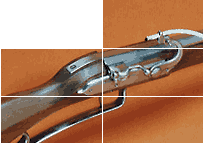
Detail of Fullers
The point of the blade is executed rather evenly, which was a nice surprise. Otherwise, few good things can be said about the fit and finish of this sword. The finish is almost a mirror polish, even though it is advertised as having a satin finish. Machining marks are visible all over the blade, and these are quite deep and hard to remove. The flats of the blade are not, in fact, flat, but wavy. The execution of the three fullers is abysmal. The fullers vary in depth and width, and are rather wobbly. The blunt edges of the blade are very wavy and formed by a very steep secondary bevel. Even though such problems are expected for swords in this price range, the degree of unevenness and waviness on the Mercenary sword exceeds that of competing products in the same price range.

The hilt construction as sold is not strong enough to handle much cutting. The guard and grip are both epoxied in place, and the pommel is threaded onto the tang. The one-piece, dark wooden grip is round in cross-section, has a metal washer at each end and is pierced by a round hole through which the tang passes. The grip is held in place by large amounts of epoxy glue placed on each end of the grip and in the gaping spaces between the grip and the tang. I believe that if there were no spaces between the hilt and the grip, if the grip were bound with cord, and if the tang were thicker, the grip would not have broken during testing.

The holes for the tang in both the guard and pommel are misaligned. This is particularly problematic in the case of the pommel, as it makes the mass distribution uneven. The pommel features many casting pits, which were filled with a different steel after the casting. The sword comes with a thick, generic leather scabbard.

To make this sword more comfortable during handling, and to hide some of its aesthetic flaws, I aged the blade and hilt components, shortened the guard making it one of Style 1, and reshaped the grip to a more appropriate oval form. With these changes, the sword is not only more presentable, but also feels much better in the hand.

Conclusion
I do not think that this sword captures the essence of the medieval sword. What is even worse is that it is not constructed properly enough for one to begin addressing the finer and more detailed aspects of the design, performance and dynamic properties of swords in general. Hilt construction is the most severe design flaw. If this were fixed, then the sword could withstand more robust cutting tests and would at least qualify as functional. These changes would not improve the dynamic properties of the blade, but this is not a requirement for swords in this price range.

I would not recommend this sword to anyone intending to do much cutting, nor would I recommend it to experienced and selective collectors or martial arts practitioners. It makes a decent wall-hanger if found at a bargain price, as it does have some aesthetic appeal. It is also good for swinging around, solo-drills and very light cutting. I find it most suitable for home-improvement projects-sharpening, antiquing, re-gripping, etc. However, the retail price of $230 US is far too much to pay for a sword of this quality.


About the Author
Alexi is a doctoral student in the biological sciences at MIT. He has had an outstanding interest in medieval military history and weaponry for many years, but only started collecting in late 2003. His main interests lie towards European weapons and warfare practices of the 13th and 14th centuries.

Acknowledgements
Photographer: Alexi Goranov


Click photos to enlarge:


All contents © Copyright 2003-2008 myArmoury.com — All rights reserved

Open a printer-friendly version of this page

You must be logged in to access all the features of myArmoury.com.
Your name: I forgot my password
Register for an account
Password:  Log me on automatically each visit
Why register? See our Membership Plans for details.