



|
|
|
|
Jiří Klepač Late-14th Century Hourglass Gauntlets A hands-on review by Michael P. Smith The 14th century is known as the transitional period in armour for good reason. At the beginning of the century, the elite soldiers of the knightly class were still primarily protected by mail. By the end of the century, the "White Harness" of completely integrated plate armour began to appear. Nowhere is this transition more evident than in the armour for the hand. Although separate gauntlets consisting of mittens covered with scales of whalebone or metal first appeared in the late 13th century, in 1300 the most dominant form of hand protection by far was the simple mail mitten attached to the sleeve of the hauberk. Separate gauntlets consisting of small plates riveted to the inside or outside of a glove appear in the second quarter of the century. The first early versions of the type that was to dominate the second half of the century, the so-called "hourglass" gauntlets, began to appear about 1350. The hourglass gauntlet style is usually understood to mean a gauntlet with a single large plate covering the back of the hand, including the base of the thumb (called by modern scholars the "metacarpal plate"), and a rigid flaring cuff, giving the gauntlet its defining hourglass shape. It is likely that on early examples the metacarpal plate and the cuff were attached to the foundation glove separately. Gauntlet 10 from the Wisby finds is possibly the cuff of such an early example. Between 1350 and 1370 the hourglass design gradually developed. The fully developed form probably appeared in the 1360s and by about 1375 was almost universal. The gauntlets of Edward of Woodstock (commonly known as the Black Prince) in Canterbury Cathedral are an excellent example of this style from the late 1370s. These gauntlets are also important because they are the most complete extant, retaining most of their fingerplates. Common features included spiked knuckle plates and protrusions over the third knuckle on the metacarpal plate, both referred to as "gadlings." Another very important feature on most, if not all, gauntlets of this style, is the so-called "knuckle-rider" plate. This is a plate between the metacarpal plate and the fingerplates. It is articulated with rivets to the metacarpal plate and is riveted to the finger leathers that the fingerplates are riveted to. This allows the plate to cover the gap between metacarpal plate and the fingerplates, while allowing the fingers to be fully extended. 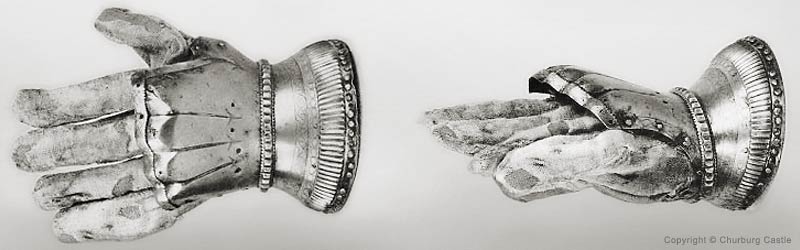 Antique gauntlet associated with the Churburg #13 harness found at Churburg Castle. The style continued to develop through the remainder of the century. The surviving examples at Churburg Castle represent the dominant style from about 1380-1400. The metacarpal plate and cuff were raised from a single piece of metal, though the gauntlets often have a decorative bracelet that may be a vestige of the time when the cuff and metacarpal plate were separate plates riveted together. The third knuckle area is usually well defined, and may include gadlings. The knuckle-rider plate, or evidence of it, is evident on virtually all surviving examples from this period. Only a few fingerplates survive, but those that do confirm the basic construction technique used on the Black Prince's gauntlets. The style remained popular into the early 15th century and was probably the dominant style in use by the men-at-arms at Agincourt. Fairly quickly though, the cuff began to flare less and lames were added at the wrist to facilitate movement. The reign of the hourglass gauntlet was over. Overview Could not connect to link database |