| Author |
Message |
Nate C.

|
 Posted: Sun 15 May, 2005 4:50 pm Post subject: Posted: Sun 15 May, 2005 4:50 pm Post subject: |
 |
|
We haven't had any posts in here for a while so here's a few to get us started again. Truth is again more fantastic than fantasy. 
Nathan - I finally found the pic with Maximilian I's messer and longsword  . .
Cheers,
 Attachment: 37.6 KB Attachment: 37.6 KB
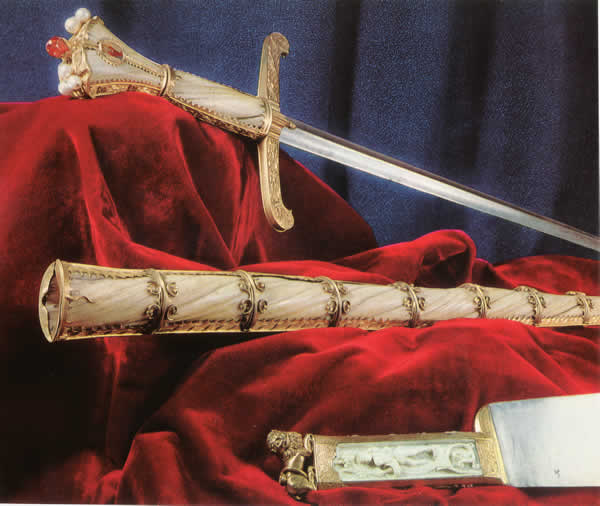
Longsword: Charles the Bold, Duke of Burgundy - gold, pearls, rubies and Narwal horn. Hunting Sword: Maximilian, son-in-law of Charles - gold and ivory
Attachment: 34.59 KB
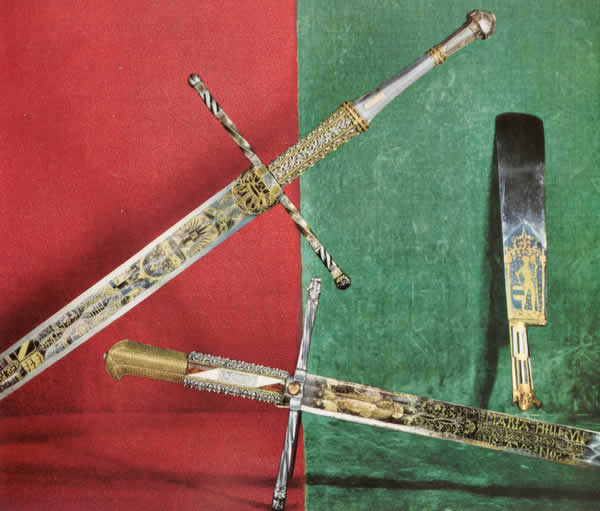
Feudal sword, hunting sword and hunting knife of Maximilian I
Nate C.
Sapere Aude
"If you are going to kill the man, at least give him a decent salute." - A. Blansitt
If they ever come up with a Swashbuckling School, I think one of the courses should be Laughing, then Jumping Off Something. --Jack Handy
|
|
  |
 |
Hisham Gaballa

|
| Posted: Wed 20 Jul, 2005 6:09 am Post subject: |
|
|
As someone who has played computer Fantasy Role playing games and posted on RPG forums I couldn't agree more. Many fantasy games designers and players idea of a beautiful sword are grotesque and totally impractical "Anime" style swords. There are a lot of exceptions to this of course and I have myself tried to influence people into admiring more elegant and simple designs such as 15th century European longswords, Persian shamshirs and Turkish yataghans, with decidedly mixed results.
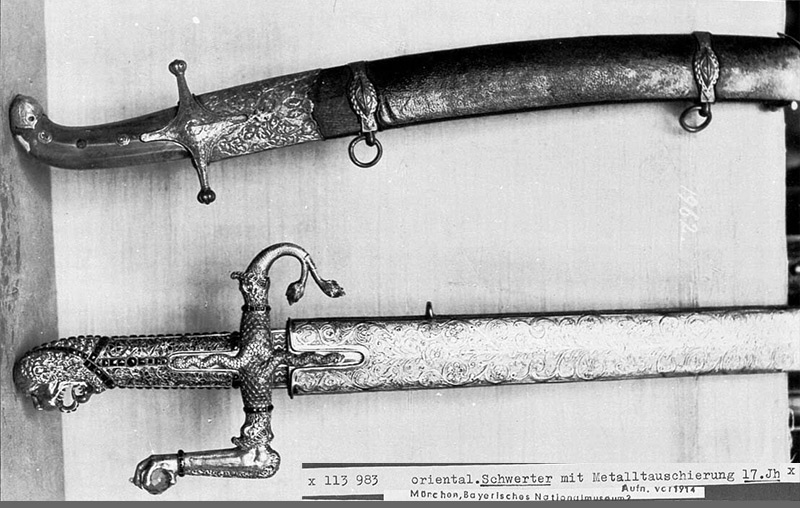
My own contribution to the pictures are these two swords from the "Blessed Swords" collection in the Topkapi Museum in Istanbul. These are swords attributed to the Prophet Muhammad and his companions while some of these are undoubtedly early Arab swords, others seem to be 15th century century Iranian swords. These two belong to the latter category.



Because of the Blessed Swords status as "sacred relics", many have been elaborately ornamented and decorated in later periods which makes dating them even more difficult.
|
|
|
|
|
Bill Grandy
myArmoury Team


|
| Posted: Mon 12 Dec, 2005 10:59 pm Post subject: |
|
|
That rapier is fantastic, Craig, thanks for sharing that! I love the nod to classical Greco-Roman art that was so prevalent in the Italian Renaissance.
HistoricalHandcrafts.com
-Inspired by History, Crafted by Hand
"For practice is better than artfulness. Your exercise can do well without artfulness, but artfulness is not much good without the exercise.” -anonymous 15th century fencing master, MS 3227a
|
|
 |
|
Craig Peters

|
| Posted: Mon 12 Dec, 2005 11:03 pm Post subject: |
|
|
| Bill Grandy wrote: | | That rapier is fantastic, Craig, thanks for sharing that! I love the nod to classical Greco-Roman art that was so prevalent in the Italian Renaissance. |
Bill,
If you haven't done so recently, I highly recommend you and anyone else who's interested to have a look at some of the items listed in the various auction houses linked to myArmoury. There's plenty of other decorative historical weapons that one could include for this thread.
|
|
|
|
|
Alexander Hinman

|
| Posted: Tue 13 Dec, 2005 8:46 am Post subject: |
|
|
Craig, those are some really awesome swords.
The one I find really interesting and quite curious is the falchion with the African heads on the pommel and crossguard. I mean, thinking in terms of the position of most Europeans toward Africa at the time, it makes me wonder why you would model a sword on a caricatured African's head.
Alot of this detail Is amazing. The level of etching, casting, etc. are all spectacular, and I think it's unfortunate (mostly for our interests) modern rulers don't greet each other with gifts of a similar type (an etched Winchester, perhaps)
One thing I've noticed about all of these ornate swords is that the basic shape of the blade is simplistic in comparison to many of the fantasy blades I've seen (with jagged serrations, holes, and divots etc.) so in that respect, I wonder if there are any historical examples of odd-shaped blades. I doubt there would be, but hey, it's worth asking.
|
|
|
|
|
|
Felix Wang
|
| Posted: Tue 13 Dec, 2005 10:33 am Post subject: |
|
|
|
Entering this discussion at a very late date, it seems to me that a dividing line can be drawn somewhere around 1400 to 1450; swords after this time are generally decorated (even models made for mass distribution to enlisted men tend to have some trim - eagle-head pommel, rope trim to the guard, and so on); and later swords often show decoration that alters the outline of the weapon. It is in the earlier period that most of the plain (and they can be very plain) war swords are seen - i.e. a spike hilt and disc pommel, and nothing else. There are a small fraction of the swords of this period that are elaborately decorated - but the decoration is entirely on the surface. If these swords are back-lit, their silhouettes are identical to those of many of their plainer brethren. As a generalization, it seems the decorated swords of the earlier era belong to persons of very high status - princes and kings; whereas many of the Renaissance and later elaborate swords belong to persons of rank, but nothing like royalty.
|
|
|
|
|
Nathan Robinson
myArmoury Admin

|
|
 |
|
|
Peter Johnsson
Industry Professional
|
| Posted: Sun 14 Feb, 2010 6:06 am Post subject: |
|
|
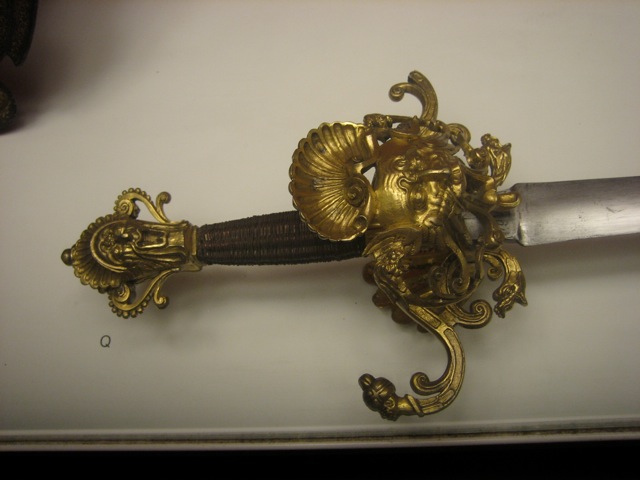
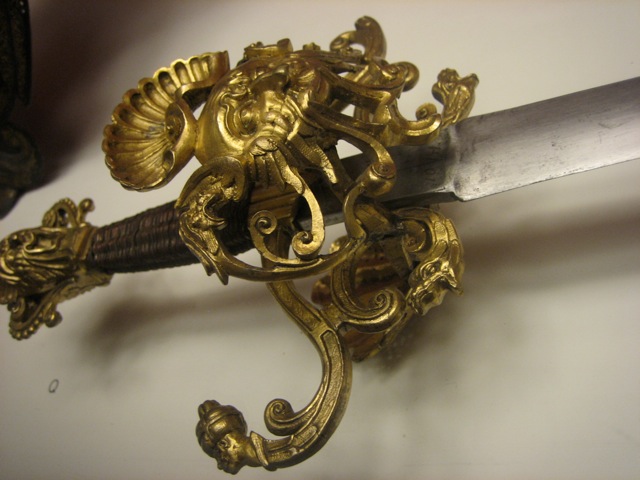
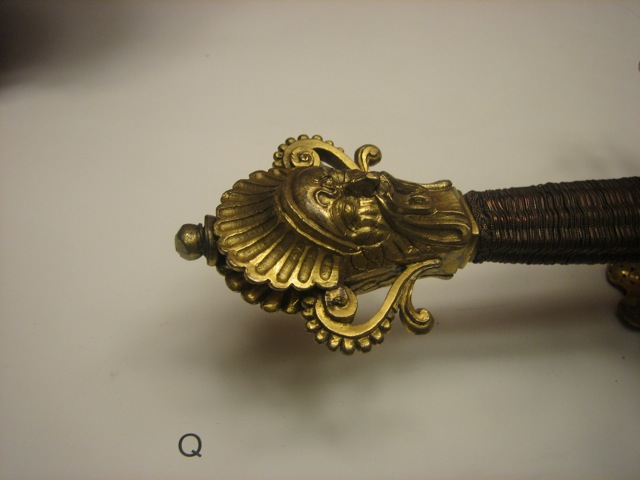
I have a soft spot for this one and know I need to make something like it one fine day.
This is from a time period when fantasy (or mythology and symbols) was a respected field of learning. Displaying the fantastic was not so much an expression of escapism as a way to show an understanding of the mysteries of the world.
Attachment: 61.81 KB
Attachment: 80.42 KB
Attachment: 54.34 KB
|
|
|
|
|
|
Peter Johnsson
Industry Professional
|
| Posted: Sun 14 Feb, 2010 6:13 am Post subject: |
|
|
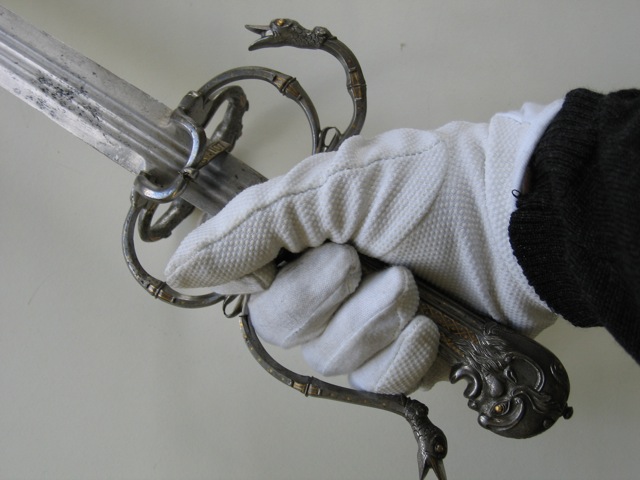
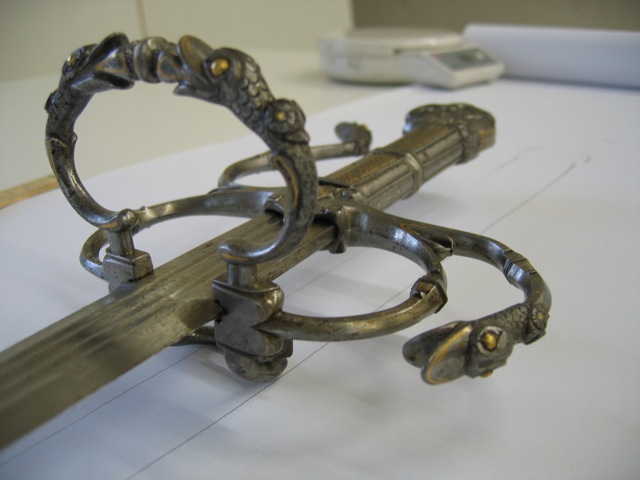
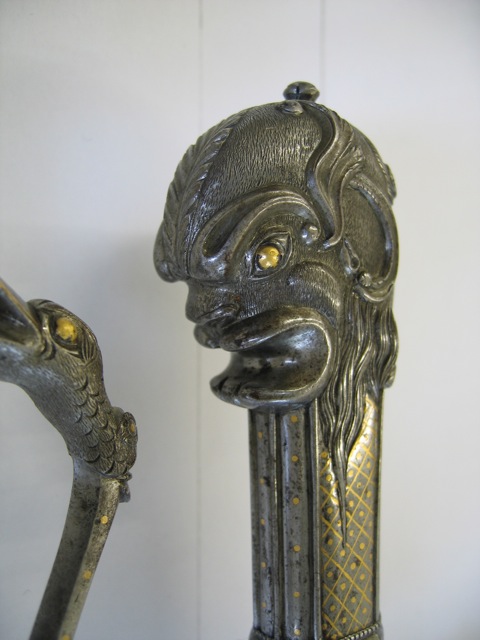
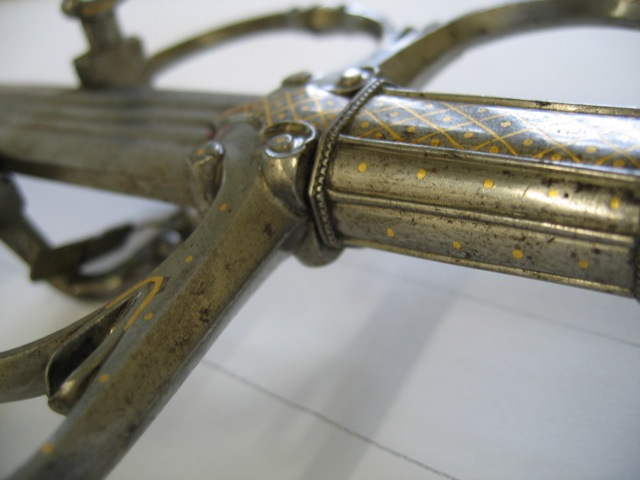
Another fantastic sword of truly incredible workmanship.
I am in awe of this piece. Cut steel and gold inlay. The blade is a no nonsense fighting blade and the balance is that of a serious weapon.
Attachment: 72.43 KB
Attachment: 60.21 KB
Attachment: 69.8 KB
Attachment: 63.15 KB
|
|
|
|
|
Nathan Robinson
myArmoury Admin
|
| Posted: Sun 14 Feb, 2010 12:52 pm Post subject: |
|
|
| Peter Johnsson wrote: | Another fantastic sword of truly incredible workmanship.
I am in awe of this piece. Cut steel and gold inlay. The blade is a no nonsense fighting blade and the balance is that of a serious weapon. |
I love that piece as well, Peter. Thank you for taking the time to post the photos. I've been told on numerous occasions by those handling such weapons that many of these are made with a great attention to the dynamics and balance so that they are very clearly intended to be used. I think you summed it up very nicely when you mentioned that the topic of "fantasy" was not really intended as escapism. Very concise and accurate summary there.
Cheers.
.:. Visit my Collection Gallery :: View my Reading List :: View my Wish List :: See Pages I Like :: Find me on Facebook .:.
|
|
|
|
|
Maurizio D'Angelo

|
| Posted: Mon 15 Feb, 2010 5:03 am Post subject: |
|
|
sword beautiful.
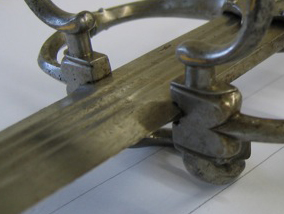
But will the quillon so mounted on the blade, resonates to the vibrations? Of course when the blade impacts.
Serves to stiffen the blade?
I refer to the details below.
Attachment: 57.44 KB
Ciao
Maurizio
|
|
|
|
|
|
Peter Johnsson
Industry Professional
|
| Posted: Mon 15 Feb, 2010 5:35 am Post subject: |
|
|
Maurizio,
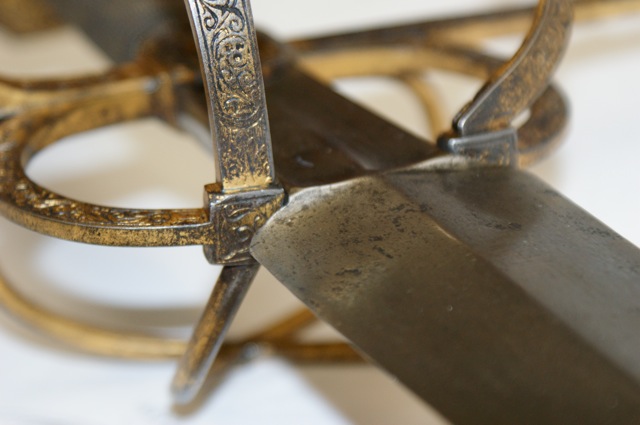
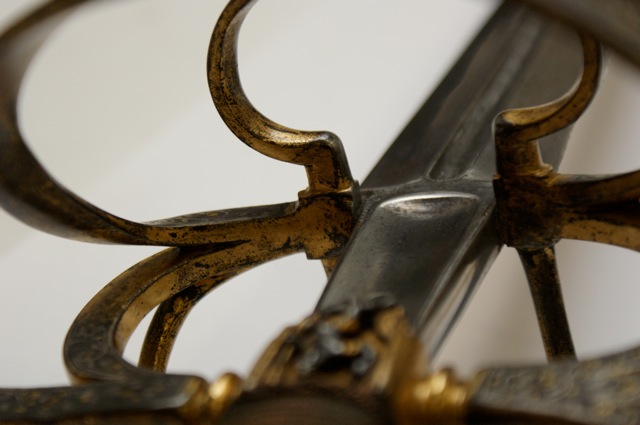
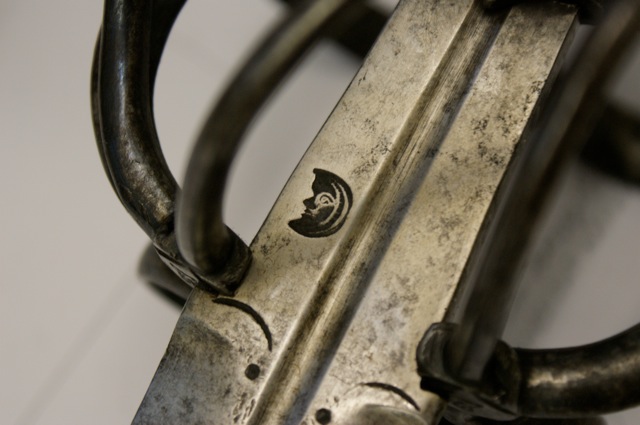
This is a detail that many swords share: the arms of the guard grabs on to the sides of the ricasso. It was not to stiffen the blade, I think, but serves to make the hilt more secure. In some cases (like the embellished sword I posted) the arms are not very hefty and may be well served by extra support.
It is not a universal feature. Not all swords are fitted like this. Especially in collections today when old blades and old hilts have been mixed and matched the fit is as a norm not at all precise. I have a feeling it was a bit more common originally, when the cutler fitted a hilt to an original blade or tweaked a hilt for better fit in a remounting.
A few examples where the arms grip around or pinch strongly against the sides of the ricasso:
(And what some kind of thin padding, like textile or thin leather between the arms and the ricasso in the top two examples, isn´t. It is just grit and dust.)
Attachment: 59.75 KB
Attachment: 56.53 KB
Attachment: 66 KB
|
|
|
|
|
Maurizio D'Angelo
|
| Posted: Mon 15 Feb, 2010 11:38 am Post subject: |
|
|
Hello Peter,
Thanks for the comprehensive response, is greatly appreciated.
thanks for posting these photos, are not common, at least for me.
I know this is completely off topic, but yesterday I saw Arn, the last knight (I see very little TV, almost never) I was fascinated by that sword.
I write to you today, as is a small world ... 
Ciao
Maurizio
|
|
|
|
|
Shahril Dzulkifli

|
| Posted: Sun 07 Mar, 2010 8:11 am Post subject: Re: Ornamentation: Fantasy vs. History (photo-intensive) |
|
|
Szczerbiec*, the sword used during the coronation of kings in Poland

The ricasso, hollowed, shows the Polish royal arms (a white eagle on a red shield)
Engravings on handle and guard

*pronounced sh-cherb-yets
“You have power over your mind - not outside events. Realize this, and you will find strength”
- Marcus Aurelius
Last edited by Shahril Dzulkifli on Sun 07 Mar, 2010 4:09 pm; edited 1 time in total
|
|
|
|
|
Sander Marechal

|
| Posted: Sun 07 Mar, 2010 1:15 pm Post subject: |
|
|
|
Wow. Is the color on that blade for real? Or an artifact of the photography?
|
|
|
|
|
Bartek Strojek

|
| Posted: Sun 07 Mar, 2010 1:47 pm Post subject: |
|
|
I don't recall anything about any color/effects on the blade, so that's probably just photo.
Unfortunately, I can't find detailed photos of the blade, guess that museum tries to enforce people to come and see themselves. 
There are nice details of the grip available though
http://en.wikivisual.com/images/7/72/Szczerbiec.jpg
|
|
|
|
|
Shahril Dzulkifli
|
| Posted: Sat 03 Apr, 2010 4:10 am Post subject: Re: Ornamentation: Fantasy vs. History (photo-intensive) |
|
|
Replacements for the first one (U.R.L. links expired)


“You have power over your mind - not outside events. Realize this, and you will find strength”
- Marcus Aurelius
|
|
|
|
|
|
Lafayette C Curtis
|
| Posted: Sun 04 Apr, 2010 4:29 am Post subject: |
|
|
| Peter Johnsson wrote: | I have a soft spot for this one and know I need to make something like it one fine day.
This is from a time period when fantasy (or mythology and symbols) was a respected field of learning. Displaying the fantastic was not so much an expression of escapism as a way to show an understanding of the mysteries of the world. |
That sword has an oddly "steampunk" look. Now I must keep one of my girl friends well away from this thread or she'll start badgering me to commission a replica.....
|
|
|
|
|
C. Stringer

Location: Minnesota Joined: 28 Jan 2010
Posts: 5
|
| Posted: Sun 04 Apr, 2010 4:26 pm Post subject: |
|
|
Heh, I don't think anyone can really argue as to whether or not real swords were ever ornamented after seeing this discussion. Some are downright beautiful pieces art, as well as deadly weapons. Win-win all around.
Nothing Gold can stay...so let us wait for the coming day...
|
|
|
|
|
|
George E
Location: MA, USA Joined: 03 Jan 2010
Posts: 6
|
| Posted: Fri 04 Jun, 2010 10:00 pm Post subject: |
|
|
| C. Stringer wrote: | | Heh, I don't think anyone can really argue as to whether or not real swords were ever ornamented after seeing this discussion. Some are downright beautiful pieces art, as well as deadly weapons. Win-win all around. |
definitely agreed, however, there is something very important to mention.
Most of the swords displayed in this thread are ceremonial swords. Most swords that would be used in battle had little to no ornaments, especially in the blade (getting an etching that someone took a lot of time to complete scratched/destroyed by another blade is not something most people would want). With that being said (and using the same comparison as the OP), would I bring out an Anduril to a battle... well, it's too heavy (as many manufacturers have mentioned, mainly due to the pommel) and there are simply better performing swords out there, which, though not as "pretty" get the job done better.
So, in short:
In battle: Undecorated Historical vs. Slightly Decorated Fantasy (historical wins)
For show: Heavily Decorated Historical vs. Decorated Fantasy (historical wins)*
*Let's use Conan's sword for this one... any of the swords displayed here would be a better choice, and they would not break the belt supporting it... (oh boy, I can feel Conan fans charging at me... better get my knight out... and a shield, which they can't use *muhahahaha*)
|
|
|
|
|
|
|







 This is a